You're not staying for love. You're staying for the labour.

There is a question that anyone who has stayed too long in a failing relationship eventually has to answer. Not for their friends, not for their therapist, but for themselves: If I met this person today, would I choose them? Most people already know the answer. They have known it for months, maybe years. And yet they stay.
This is not a character flaw. It is not codependency, or fear, or a failure of nerve, though it can look like all three. Examining the behavioral economics of staying in relationships reveals the predictable output of cognitive systems that our brains developed long before "relationship" was a word—systems that evolved to reward effort, punish abandonment and treat the things you have built as inherently worth protecting. Two of these systems, the IKEA effect and the sunk cost fallacy, are so well-documented in the behavioral literature that they have begun attracting the attention of neuroscientists.
What you built is worth more because you built it
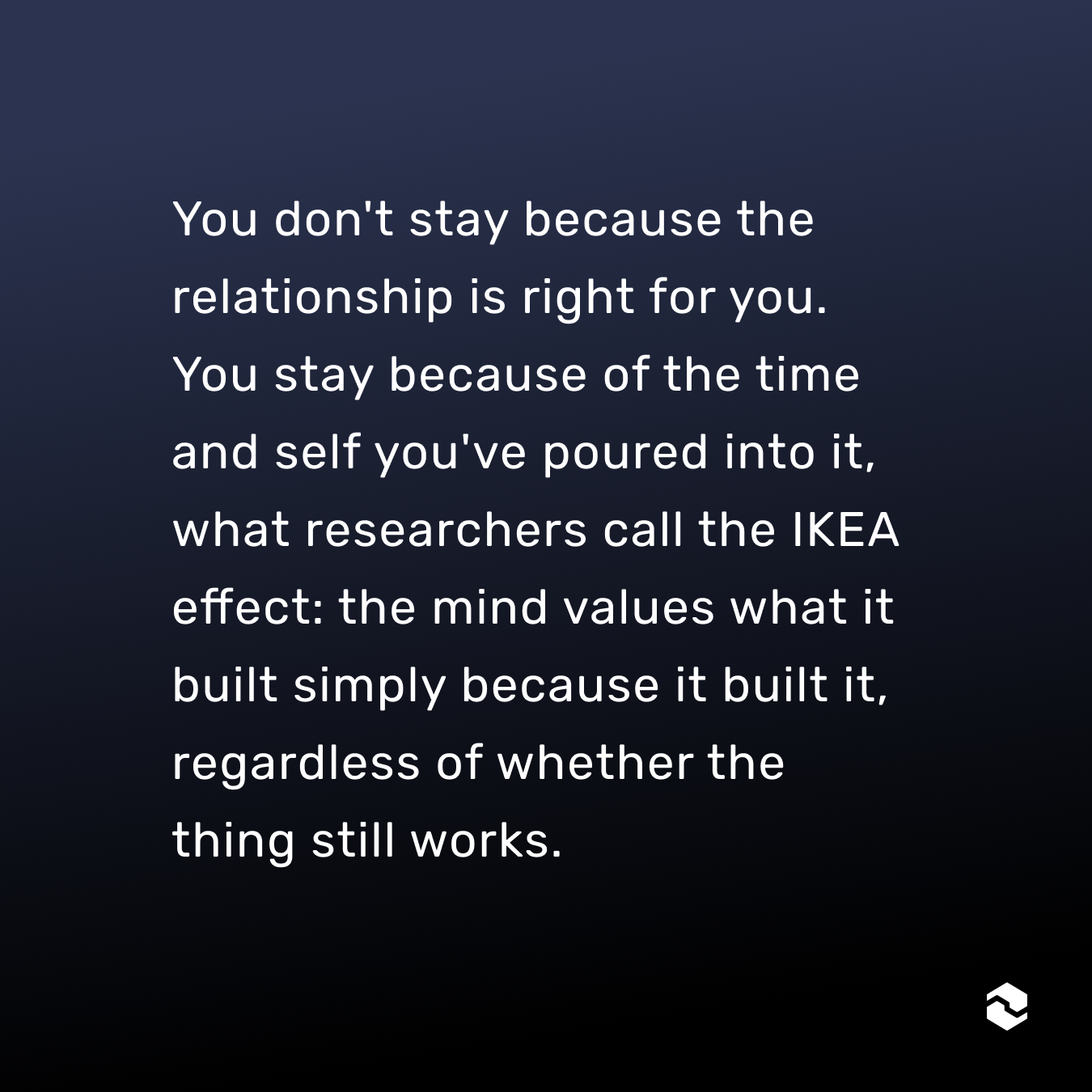
In 2012, three researchers published a paper that has since become one of the most widely cited in behavioral economics. Michael Norton, Daniel Mochon and Dan Ariely asked participants to assemble IKEA boxes, fold origami and build Lego sets [2]. Then they asked how much the finished objects were worth.
The results were precise and a little humbling. People who had assembled their own products valued them significantly higher than identical pre-assembled products. Builders rated their own amateurish origami cranes as roughly comparable in value to an expert's. They expected others to agree. Two things turned out to be necessary for the effect to appear: the effort had to be yours, and it had to result in something finished. Participants who built a Lego set and then watched it be dismantled showed no overvaluation. Those who completed only half an IKEA box valued it less than those who finished [2].
The authors named this the IKEA effect. It has since been replicated across dozens of studies and extended into domains well beyond furniture, including, in a 2023 meta-analysis of 31 studies, persuasive writing and communication [6]. When psychologists study the IKEA effect in relationships, they find the mechanism holds everywhere it has been tested: effort leads to overvaluation, but only when the effort is yours, and only when it ends in something completed.
Now substitute the box for a relationship. The product built is not furniture. It is the shorthand you developed for talking about your families. The trip you salvaged after the flight was cancelled. The apartment you painted together over a long weekend and the argument about the color that you laugh about now. Each of these, each joint project that actually worked, has been quietly inflating your valuation of the whole enterprise in ways you did not choose and probably did not notice.
The language of staying
There is a specific vocabulary that develops around the decision to stay in a relationship that is no longer working. We've been through so much together. I can't just throw it all away. Things will get better once the stress lifts. Nobody knows me the way they do. We've built a life.
These phrases do not sound like rationalisations when you are saying them. They sound like facts. What makes them so convincing is that they are not entirely wrong. You have been through a lot. Life is real. The accumulated knowledge between two people over years, including who needs what after a bad day, which topics to avoid at dinner and where the other person is most fragile, is not nothing to lose.
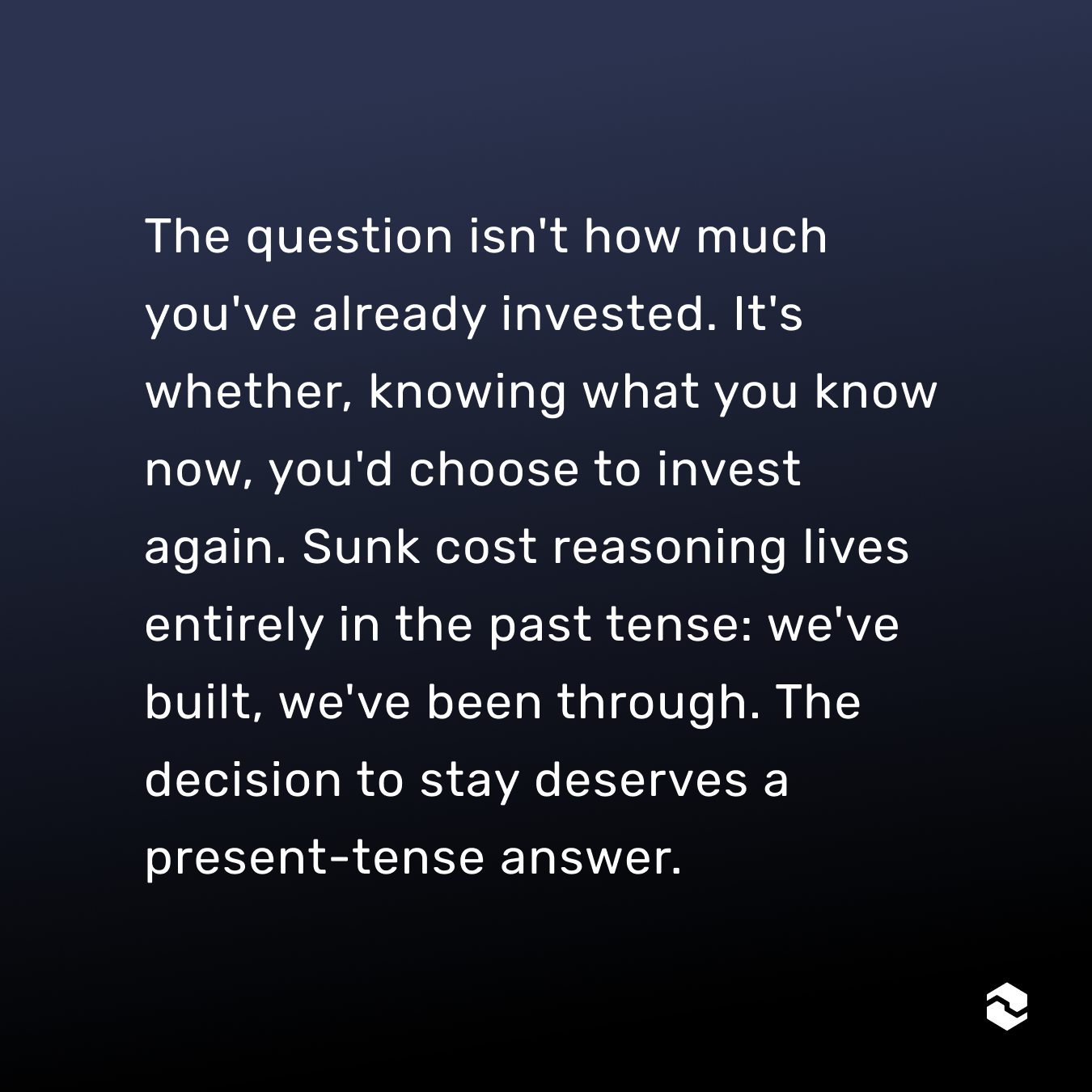
But notice what the language is doing. We've been through. We've built. I can't throw it away. The tense is past. The justification lives entirely in what has already happened, which is the grammatical signature of the sunk cost fallacy, a bias so deeply woven into how we talk about relationships that we rarely notice it operating.

There is a companion vocabulary too, quieter and harder to catch. It is the language of minimisation. Every couple goes through rough patches. He's not a bad person. It's not like he hits me. This one works differently. Where the first set of phrases inflates the past investment, the second deflates the present cost. Together they form a closed system, the past made large, the present made small; inside that system, leaving becomes almost impossible.
What is striking, if you step outside the system for a moment, is how little of this language is about the future. Almost none of it asks: what will this look like in five years? The future tense barely appears, except in the form of vague hope: things will get better, which is a future that requires no action and makes no promises. You end up making a decision about the future entirely in the vocabulary of the past.
The brain that counts what you spent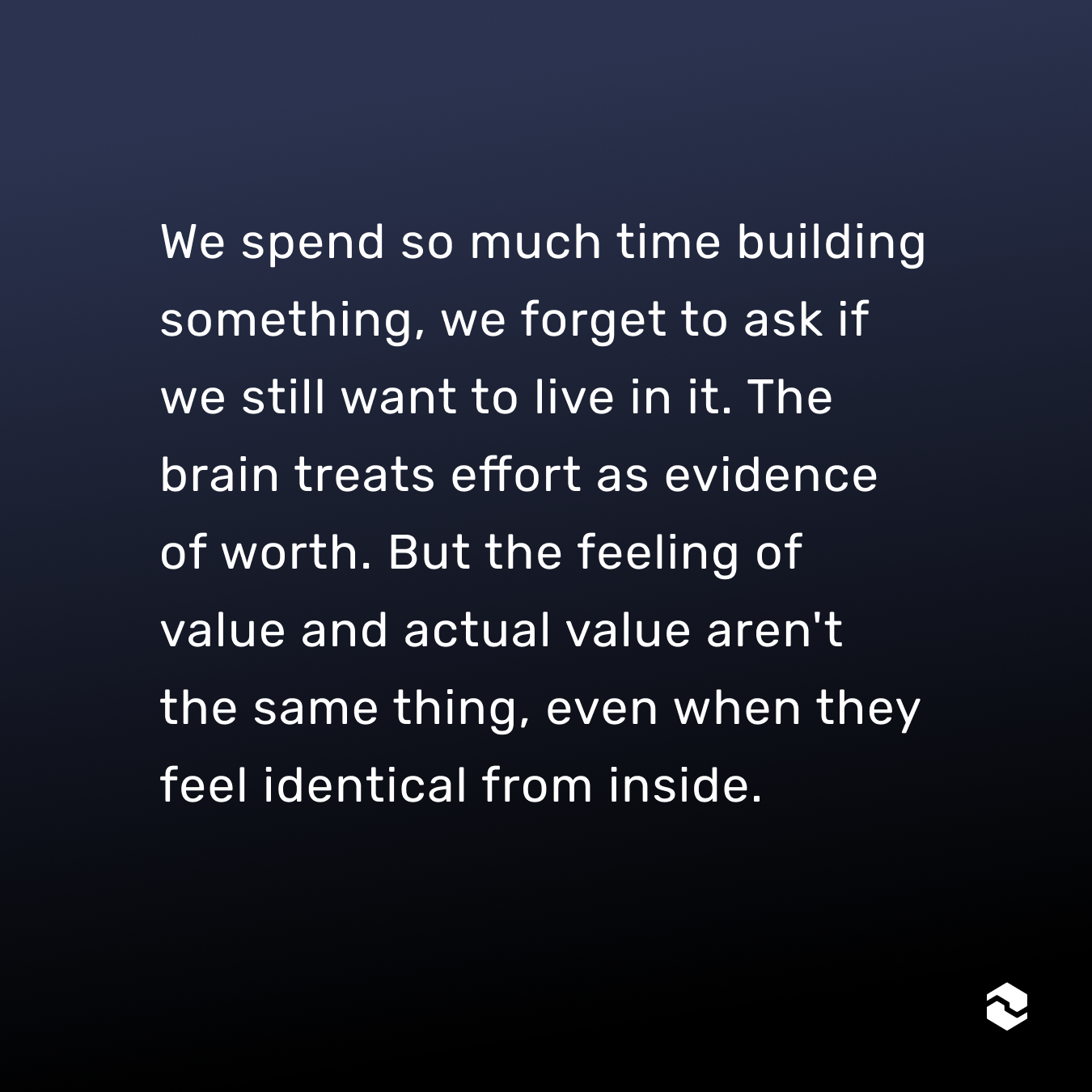
The sunk cost fallacy has a neural basis, and it is worth understanding.
A 2009 study by Prévost and colleagues at Oxford scanned participants' brains while they performed effortful tasks to earn monetary rewards [4]. What they found was that two brain regions, the ventral striatum, part of the reward system, and the dorsal anterior cingulate cortex, were doing something specific. They were not just registering how good the reward was. They were calculating net value: what you get, minus what it costs you to get it. The effort was being subtracted from the reward in real time, and the result was what the brain treated as the true worth of the thing.
A 2018 study by Arulpragasam and colleagues at Vanderbilt pushed this further by looking at efforts that hadn't happened yet [1]. Participants were asked whether they wanted to accept rewards that would require physical effort in the future. Even in anticipation, before any effort was expended, the brain was already discounting the reward against the projected cost. The ventromedial prefrontal cortex, a region involved in computing subjective value, tracked how much effort participants expected to face and adjusted its assessment of the reward accordingly.
A 2024 study by Culbreth and colleagues at the University of Maryland confirmed that this calculation is not specific to physical tasks [9]. Whether participants were doing cognitively demanding memory work or effortful speech comprehension, the same brain region, the dorsal anterior cingulate cortex, was tracking the relative value of the easier versus harder option. The same structure, the same calculation, regardless of what kind of effort was involved.
None of these studies scanned people deciding whether to leave a romantic partner. But the architecture described is not domain-specific. These regions do not distinguish between the effort of moving a trackball in a laboratory and the effort of three years of emotional labor. When your brain evaluates your relationship, it runs the same calculation it runs for any costly investment, and years of shared history produce a valuation signal powerful enough to override the evidence in front of you.
A 2025 paper by Białek and Biesiada found that standard measures of the sunk cost fallacy have surprisingly poor reliability, meaning the feeling of I've invested too much to leave is even less precise and less trustworthy as a guide than it presents itself [5].
What love does to risk perception
There is another layer to this, which concerns not how your brain values what you built but how clearly it can see what is wrong with it.
A 2025 study by Nakagawa and colleagues recorded the brain activity of forty people in romantic relationships while they made decisions that carried risk, decisions that would affect their partners, their mothers, or strangers [7]. When making decisions that involved their romantic partners, participants showed measurably reduced activity in the neural systems associated with conflict monitoring and risk detection. The brain's alarm system, in other words, ran quieter for partners than for anyone else, even quieter than for their own mothers.
This is not a flaw in how love works. A pair-bond that triggered constant risk alerts would be exhausting and probably unsustainable. But it does mean that the overvaluation produced by the IKEA effect is compounded by a reduced ability to notice the relationship's problems clearly. You are not just cognitively biased toward what you built. You are neurologically less alert to what is breaking down.
The outside view
The research on how people perceive their partners arrives at a conclusion that is both reassuring and uncomfortable: your perceptions are simultaneously accurate and biased [3]. You are not wrong about your partner in some wholesale way. But you are systematically swayed by the desire to maintain the relationship, by years of confirmed expectations of seeing them as better for you than the evidence strictly supports. Researchers call this motivated wishful thinking: the relationship you want to have shapes the relationship you believe you have.
A 2025 study from Syracuse University found something telling: when people evaluated hypothetical relationships from a third-person perspective, imagining it was someone else's situation, they were significantly more likely to recommend leaving than when they imagined themselves inside the same relationship [8]. The facts were identical, perspective changed everything.
A friend who loves you and has watched your relationship for years will sometimes say something that stops you cold, not because they know something you don't, but because they are not subject to the effort-induced overvaluation. They do not carry the IKEA effect for your relationship. They never built it. They can see it the way you would see a stranger's relationship. The same relationship that feels irreplaceable from within often looks different from the outside.
The self you leave behind
What neuroscience does not capture, and what the behavioral frameworks miss, is the specific texture of what it costs to leave. It is not just the relationship you are losing. It is the version of yourself that exists inside it.
This sounds abstract until you try to name what actually goes. The person who had a standing joke with someone. Who knew, without asking, that Tuesday nights meant takeout and bad television and that this was a form of happiness. Who had been witnessed, not perfectly, not always kindly, but consistently, over time by another person who knew where you came from and roughly what you were afraid of. That self, the one who was known, does not automatically survive the ending.
People who have left long relationships often describe a period that is not quite grief and not quite relief but some disorienting combination of both, overlaid with a kind of identity vertigo. You reach for references that no longer exist. You start to tell a story and realize halfway through that the person who would have found it funniest is the person you just left. You notice your own habits and realise they were formed around someone who is no longer there. The shape of the absence is exactly the shape of what you built together. This is what the IKEA effect costs you on the way out.
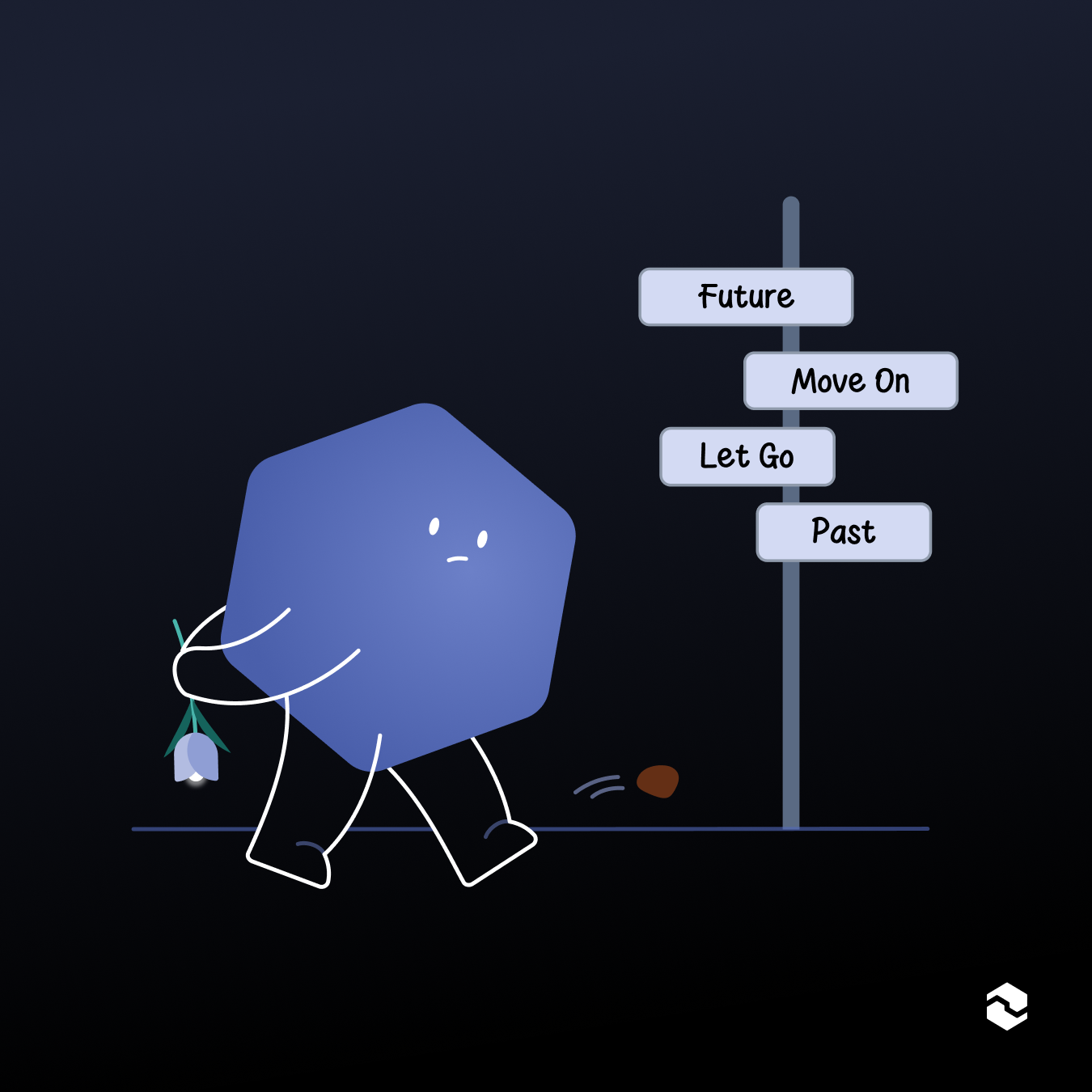
There is also the question of the narrative. Long relationships accumulate a shared story of how you met, what you survived, the version of each other you have become. Leaving requires rewriting that story, or at least finding a way to hold it differently, and this is hard. The story was not just something you told other people. It was something you told yourself, a way of understanding who you are and how you got here. Without it, the past can feel suddenly unmoored.
None of this means staying is the right choice. But it is worth naming honestly, because the decision to leave is often discussed as if understanding the IKEA effect should be enough to dissolve the attachment. It is not. The attachment is also made of real things: real time, real intimacy, a real self that was shaped by the relationship.
The loop that closes itself
 These forces do not operate independently. They interact, and they reinforce each other. Effort produces overvaluation through the IKEA effect [2, 6], your brain treats the relationship as more valuable than objective indicators suggest [4]. Overvaluation produces continued investment: you stay, you try harder, you give it one more month. Continued investment produces more effort. More effort produces more overvaluation. The loop closes.
Meanwhile, motivated wishful thinking biases your perception of your partner [3]. Romantic attachment attenuates the neural signals that would otherwise register risk [7]. The anticipation of future effort, the couples therapy, the hard conversations and the work of rebuilding, is already being discounted into the calculation before it has even begun [1, 9]. Sunk cost reasoning tells you that leaving would make the past meaningless [5]. And the outside view, the one perspective that might break through, is structurally unavailable to someone who is inside the relationship [8].
What you can do with this
Understanding the mechanism does not automatically free you from it. The brain regions that compute effort-discounted value do so whether you consent to the process or not [4, 9]. Knowing you are biased does not restore unbiased perception. But it does create something useful: distance. A small gap between the feeling and the decision.
A few things are worth trying. Ask someone outside. The IKEA effect requires self-produced effort [2]. A trusted friend or therapist evaluating your relationship is not subject to the same inflation you are. They built nothing. They owe the relationship nothing. Research confirms that third-person perspective significantly changes how people assess identical situations [8]. Ask them what they see and then, this is the harder part, actually listen.
Ask the counterfactual question. The sunk cost fallacy lives in the past. The corrective question lives in the present: Would I start investing in this relationship today, given what I now know? If the answer is no, the only reason to stay is the past itself, which cannot be changed by staying.
Distinguish effort from endurance. The IKEA effect requires successful completion [2, 6]. A relationship characterised by chronic, unresolved conflict is not a series of joint projects you finished together. If you cannot identify specific things you successfully built together in the past year, what you are calling investment may be something else entirely.
Long-term relationships require weathering difficulties, and the brain's tendency to treat effort as evidence of value is not always wrong. Sometimes what you built is genuinely worth protecting. The question is narrower than should I stay or go. It is: how much of what I feel is the relationship, and how much is the effort I put into it?
These are not the same thing. The IKEA effect, the sunk cost fallacy and the dampened risk signals of romantic love, they do not create value. They create the feeling of value, sometimes in its absence. If I were not already here, would I choose to arrive? That question is not cruel. It is the one question the brain's valuation systems cannot answer for you.
References:
[1] Arulpragasam AR et al. Neural correlates of effort-based valuation with prospective choices. NeuroImage. 2018;185:446–454. https://doi.org/10.1016/j.neuroimage.2018.10.051
[2] Norton MI, Mochon D, Ariely D. The IKEA effect: When labor leads to love. Journal of Consumer Psychology. 2012;22(3):453–460. https://doi.org/10.1016/j.jcps.2011.08.002
[3] Ogolsky BG, Monk JK. Accuracy and bias in relationship maintenance. In: Relationship Maintenance: Theory, Process, and Context. Cambridge University Press; 2019:240–262.
[4] Prévost C et al. Effort-based cost-benefit valuation and the human brain. Journal of Neuroscience. 2009;29(14):4531–4541. https://doi.org/10.1523/JNEUROSCI.4515-08.2009
[5] Białek M, Biesiada E. On the low reliability of sunk cost vignettes. Brain Sciences. 2025;15(8):808. https://doi.org/10.3390/brainsci15080808
[6] Pelled A. When Labor Leads to Persuasion: The IKEA Effect in Persuasive Texts [Doctoral dissertation]. University of Wisconsin-Madison; 2023.
[7] Nakagawa S et al. Neurophysiological evidence of romantic love– and maternal love–specific vicarious risk and outcome processing during dynamic decision-making. Cerebral Cortex. 2025;35(6):bhaf149. https://doi.org/10.1093/cercor/bhaf149
[8] Burkle J. Causal Structure and Narrative Perspective in Romantic Relationship Judgments [Master's thesis]. Syracuse University; 2025.
[9] Culbreth AJ et al. Generalized encoding of the relative subjective value of cognitive effort in the dorsal ACC. Journal of Neuroscience. 2024;44(38):e0367242024. https://doi.org/10.1523/JNEUROSCI.0367-24.2024
You're not staying for love. You're staying for the labour.
There is a question that anyone who has stayed too long in a failing relationship eventually has to answer. Not for their friends, not for their therapist, but for themselves: If I met this person today, would I choose them? Most people already know the answer. They have known it for months, maybe years. And yet they stay.
This is not a character flaw. It is not codependency, or fear, or a failure of nerve, though it can look like all three. Examining the behavioral economics of staying in relationships reveals the predictable output of cognitive systems that our brains developed long before "relationship" was a word—systems that evolved to reward effort, punish abandonment and treat the things you have built as inherently worth protecting. Two of these systems, the IKEA effect and the sunk cost fallacy, are so well-documented in the behavioral literature that they have begun attracting the attention of neuroscientists.
What you built is worth more because you built it
In 2012, three researchers published a paper that has since become one of the most widely cited in behavioral economics. Michael Norton, Daniel Mochon and Dan Ariely asked participants to assemble IKEA boxes, fold origami and build Lego sets [2]. Then they asked how much the finished objects were worth.
The results were precise and a little humbling. People who had assembled their own products valued them significantly higher than identical pre-assembled products. Builders rated their own amateurish origami cranes as roughly comparable in value to an expert's. They expected others to agree. Two things turned out to be necessary for the effect to appear: the effort had to be yours, and it had to result in something finished. Participants who built a Lego set and then watched it be dismantled showed no overvaluation. Those who completed only half an IKEA box valued it less than those who finished [2].
The authors named this the IKEA effect. It has since been replicated across dozens of studies and extended into domains well beyond furniture, including, in a 2023 meta-analysis of 31 studies, persuasive writing and communication [6]. When psychologists study the IKEA effect in relationships, they find the mechanism holds everywhere it has been tested: effort leads to overvaluation, but only when the effort is yours, and only when it ends in something completed.
Now substitute the box for a relationship. The product built is not furniture. It is the shorthand you developed for talking about your families. The trip you salvaged after the flight was cancelled. The apartment you painted together over a long weekend and the argument about the color that you laugh about now. Each of these, each joint project that actually worked, has been quietly inflating your valuation of the whole enterprise in ways you did not choose and probably did not notice.
The language of staying
There is a specific vocabulary that develops around the decision to stay in a relationship that is no longer working. We've been through so much together. I can't just throw it all away. Things will get better once the stress lifts. Nobody knows me the way they do. We've built a life.
These phrases do not sound like rationalisations when you are saying them. They sound like facts. What makes them so convincing is that they are not entirely wrong. You have been through a lot. Life is real. The accumulated knowledge between two people over years, including who needs what after a bad day, which topics to avoid at dinner and where the other person is most fragile, is not nothing to lose.
But notice what the language is doing. We've been through. We've built. I can't throw it away. The tense is past. The justification lives entirely in what has already happened, which is the grammatical signature of the sunk cost fallacy, a bias so deeply woven into how we talk about relationships that we rarely notice it operating.
There is a companion vocabulary too, quieter and harder to catch. It is the language of minimisation. Every couple goes through rough patches. He's not a bad person. It's not like he hits me. This one works differently. Where the first set of phrases inflates the past investment, the second deflates the present cost. Together they form a closed system, the past made large, the present made small; inside that system, leaving becomes almost impossible.
What is striking, if you step outside the system for a moment, is how little of this language is about the future. Almost none of it asks: what will this look like in five years? The future tense barely appears, except in the form of vague hope: things will get better, which is a future that requires no action and makes no promises. You end up making a decision about the future entirely in the vocabulary of the past.
The brain that counts what you spent
The sunk cost fallacy has a neural basis, and it is worth understanding.
A 2009 study by Prévost and colleagues at Oxford scanned participants' brains while they performed effortful tasks to earn monetary rewards [4]. What they found was that two brain regions, the ventral striatum, part of the reward system, and the dorsal anterior cingulate cortex, were doing something specific. They were not just registering how good the reward was. They were calculating net value: what you get, minus what it costs you to get it. The effort was being subtracted from the reward in real time, and the result was what the brain treated as the true worth of the thing.
A 2018 study by Arulpragasam and colleagues at Vanderbilt pushed this further by looking at efforts that hadn't happened yet [1]. Participants were asked whether they wanted to accept rewards that would require physical effort in the future. Even in anticipation, before any effort was expended, the brain was already discounting the reward against the projected cost. The ventromedial prefrontal cortex, a region involved in computing subjective value, tracked how much effort participants expected to face and adjusted its assessment of the reward accordingly.
A 2024 study by Culbreth and colleagues at the University of Maryland confirmed that this calculation is not specific to physical tasks [9]. Whether participants were doing cognitively demanding memory work or effortful speech comprehension, the same brain region, the dorsal anterior cingulate cortex, was tracking the relative value of the easier versus harder option. The same structure, the same calculation, regardless of what kind of effort was involved.
None of these studies scanned people deciding whether to leave a romantic partner. But the architecture described is not domain-specific. These regions do not distinguish between the effort of moving a trackball in a laboratory and the effort of three years of emotional labor. When your brain evaluates your relationship, it runs the same calculation it runs for any costly investment, and years of shared history produce a valuation signal powerful enough to override the evidence in front of you.
A 2025 paper by Białek and Biesiada found that standard measures of the sunk cost fallacy have surprisingly poor reliability, meaning the feeling of I've invested too much to leave is even less precise and less trustworthy as a guide than it presents itself [5].
What love does to risk perception
There is another layer to this, which concerns not how your brain values what you built but how clearly it can see what is wrong with it.
A 2025 study by Nakagawa and colleagues recorded the brain activity of forty people in romantic relationships while they made decisions that carried risk, decisions that would affect their partners, their mothers, or strangers [7]. When making decisions that involved their romantic partners, participants showed measurably reduced activity in the neural systems associated with conflict monitoring and risk detection. The brain's alarm system, in other words, ran quieter for partners than for anyone else, even quieter than for their own mothers.
This is not a flaw in how love works. A pair-bond that triggered constant risk alerts would be exhausting and probably unsustainable. But it does mean that the overvaluation produced by the IKEA effect is compounded by a reduced ability to notice the relationship's problems clearly. You are not just cognitively biased toward what you built. You are neurologically less alert to what is breaking down.
The outside view
The research on how people perceive their partners arrives at a conclusion that is both reassuring and uncomfortable: your perceptions are simultaneously accurate and biased [3]. You are not wrong about your partner in some wholesale way. But you are systematically swayed by the desire to maintain the relationship, by years of confirmed expectations of seeing them as better for you than the evidence strictly supports. Researchers call this motivated wishful thinking: the relationship you want to have shapes the relationship you believe you have.
A 2025 study from Syracuse University found something telling: when people evaluated hypothetical relationships from a third-person perspective, imagining it was someone else's situation, they were significantly more likely to recommend leaving than when they imagined themselves inside the same relationship [8]. The facts were identical, perspective changed everything.
A friend who loves you and has watched your relationship for years will sometimes say something that stops you cold, not because they know something you don't, but because they are not subject to the effort-induced overvaluation. They do not carry the IKEA effect for your relationship. They never built it. They can see it the way you would see a stranger's relationship. The same relationship that feels irreplaceable from within often looks different from the outside.
The self you leave behind
What neuroscience does not capture, and what the behavioral frameworks miss, is the specific texture of what it costs to leave. It is not just the relationship you are losing. It is the version of yourself that exists inside it.
This sounds abstract until you try to name what actually goes. The person who had a standing joke with someone. Who knew, without asking, that Tuesday nights meant takeout and bad television and that this was a form of happiness. Who had been witnessed, not perfectly, not always kindly, but consistently, over time by another person who knew where you came from and roughly what you were afraid of. That self, the one who was known, does not automatically survive the ending.
People who have left long relationships often describe a period that is not quite grief and not quite relief but some disorienting combination of both, overlaid with a kind of identity vertigo. You reach for references that no longer exist. You start to tell a story and realize halfway through that the person who would have found it funniest is the person you just left. You notice your own habits and realise they were formed around someone who is no longer there. The shape of the absence is exactly the shape of what you built together. This is what the IKEA effect costs you on the way out.
There is also the question of the narrative. Long relationships accumulate a shared story of how you met, what you survived, the version of each other you have become. Leaving requires rewriting that story, or at least finding a way to hold it differently, and this is hard. The story was not just something you told other people. It was something you told yourself, a way of understanding who you are and how you got here. Without it, the past can feel suddenly unmoored.
None of this means staying is the right choice. But it is worth naming honestly, because the decision to leave is often discussed as if understanding the IKEA effect should be enough to dissolve the attachment. It is not. The attachment is also made of real things: real time, real intimacy, a real self that was shaped by the relationship.
The loop that closes itself
These forces do not operate independently. They interact, and they reinforce each other. Effort produces overvaluation through the IKEA effect [2, 6], your brain treats the relationship as more valuable than objective indicators suggest [4]. Overvaluation produces continued investment: you stay, you try harder, you give it one more month. Continued investment produces more effort. More effort produces more overvaluation. The loop closes.
Meanwhile, motivated wishful thinking biases your perception of your partner [3]. Romantic attachment attenuates the neural signals that would otherwise register risk [7]. The anticipation of future effort, the couples therapy, the hard conversations and the work of rebuilding, is already being discounted into the calculation before it has even begun [1, 9]. Sunk cost reasoning tells you that leaving would make the past meaningless [5]. And the outside view, the one perspective that might break through, is structurally unavailable to someone who is inside the relationship [8].
What you can do with this
Understanding the mechanism does not automatically free you from it. The brain regions that compute effort-discounted value do so whether you consent to the process or not [4, 9]. Knowing you are biased does not restore unbiased perception. But it does create something useful: distance. A small gap between the feeling and the decision.
A few things are worth trying. Ask someone outside. The IKEA effect requires self-produced effort [2]. A trusted friend or therapist evaluating your relationship is not subject to the same inflation you are. They built nothing. They owe the relationship nothing. Research confirms that third-person perspective significantly changes how people assess identical situations [8]. Ask them what they see and then, this is the harder part, actually listen.
Ask the counterfactual question. The sunk cost fallacy lives in the past. The corrective question lives in the present: Would I start investing in this relationship today, given what I now know? If the answer is no, the only reason to stay is the past itself, which cannot be changed by staying.
Distinguish effort from endurance. The IKEA effect requires successful completion [2, 6]. A relationship characterised by chronic, unresolved conflict is not a series of joint projects you finished together. If you cannot identify specific things you successfully built together in the past year, what you are calling investment may be something else entirely.
Long-term relationships require weathering difficulties, and the brain's tendency to treat effort as evidence of value is not always wrong. Sometimes what you built is genuinely worth protecting. The question is narrower than should I stay or go. It is: how much of what I feel is the relationship, and how much is the effort I put into it?
These are not the same thing. The IKEA effect, the sunk cost fallacy and the dampened risk signals of romantic love, they do not create value. They create the feeling of value, sometimes in its absence. If I were not already here, would I choose to arrive? That question is not cruel. It is the one question the brain's valuation systems cannot answer for you.
References:
[1] Arulpragasam AR et al. Neural correlates of effort-based valuation with prospective choices. NeuroImage. 2018;185:446–454. https://doi.org/10.1016/j.neuroimage.2018.10.051
[2] Norton MI, Mochon D, Ariely D. The IKEA effect: When labor leads to love. Journal of Consumer Psychology. 2012;22(3):453–460. https://doi.org/10.1016/j.jcps.2011.08.002
[3] Ogolsky BG, Monk JK. Accuracy and bias in relationship maintenance. In: Relationship Maintenance: Theory, Process, and Context. Cambridge University Press; 2019:240–262.
[4] Prévost C et al. Effort-based cost-benefit valuation and the human brain. Journal of Neuroscience. 2009;29(14):4531–4541. https://doi.org/10.1523/JNEUROSCI.4515-08.2009
[5] Białek M, Biesiada E. On the low reliability of sunk cost vignettes. Brain Sciences. 2025;15(8):808. https://doi.org/10.3390/brainsci15080808
[6] Pelled A. When Labor Leads to Persuasion: The IKEA Effect in Persuasive Texts [Doctoral dissertation]. University of Wisconsin-Madison; 2023.
[7] Nakagawa S et al. Neurophysiological evidence of romantic love– and maternal love–specific vicarious risk and outcome processing during dynamic decision-making. Cerebral Cortex. 2025;35(6):bhaf149. https://doi.org/10.1093/cercor/bhaf149
[8] Burkle J. Causal Structure and Narrative Perspective in Romantic Relationship Judgments [Master's thesis]. Syracuse University; 2025.
[9] Culbreth AJ et al. Generalized encoding of the relative subjective value of cognitive effort in the dorsal ACC. Journal of Neuroscience. 2024;44(38):e0367242024. https://doi.org/10.1523/JNEUROSCI.0367-24.2024